
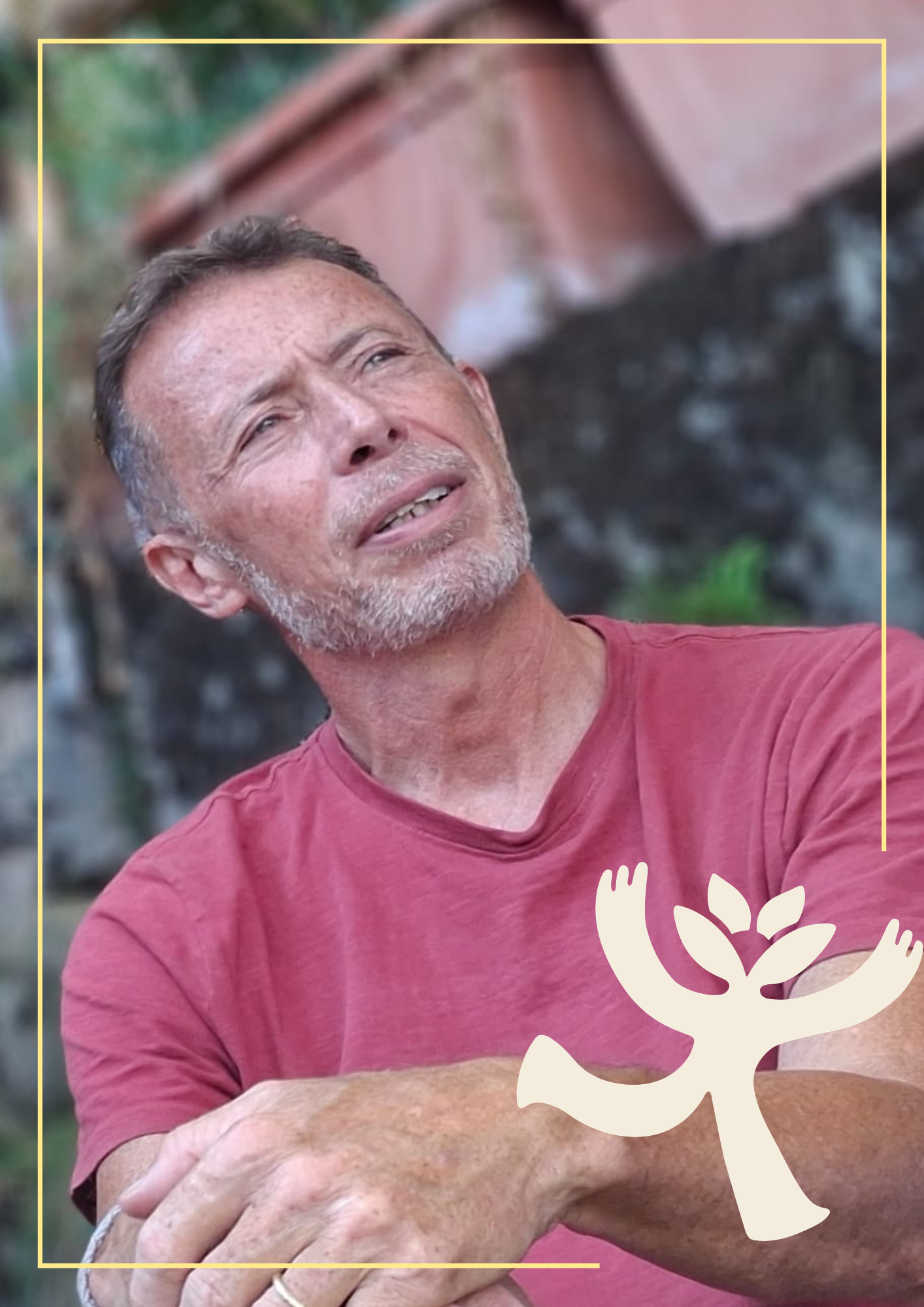
Leonardo Frontani, trainer/facilitator
Leonardo Frontani is a trainer and facilitator based in Italy. Most of his work started indoors, in seminar rooms and management courses. But since 2020 he has directed the Scuola Estiva di Pensiero Sistemico, a summer school built around systemic thinking, group dynamics and experiential learning, and it pushed him outdoors almost by necessity. "You can't teach systemic thinking convincingly while sitting still in a room with the windows closed," he says.
Over the years, nature became less a nice location for an activity and more a working partner: a source of feedback groups can't get any other way. Early on, he ran experiential sessions almost entirely indoors, with simulations, role plays and elaborate metaphors built with slides and props. They worked, but there was always a layer of performance people could hide behind. "Outdoors, that layer disappears. You can't fake being tired, cold, disoriented, or moved by a view." He saw it clearly during a corporate programme built around an expedition metaphor. The moment it moved from the conference room onto actual terrain, the groups stopped managing impressions and started genuinely collaborating. "That convinced me the outdoors isn't a nicer backdrop for the same exercise. It's a different exercise altogether."
The first thing Leonardo notices when people go outside is the drop in posturing. Indoors, people arrive with their professional mask on: hierarchy, role, image. Outside, within twenty minutes, that mask gets harder to maintain. "The terrain doesn't care about your job title." People speak more directly, laugh more easily and pay attention to each other rather than to their phones. Silence becomes usable too. Indoors it reads as awkward; outdoors it reads as normal, even necessary. Bodies loosen: shoulders drop, voices lower and walking pace synchronises. "It's a kind of unspoken negotiation of rhythm that almost never happens around a table."
One moment has stayed with him in particular. During an intergenerational management programme, the day had been built around an indoor metaphor, but the weather pushed part of the closing activity into a courtyard. The group had to physically arrange itself and its materials into a shared gallery in the open air, with no fixed seating and no assigned spot. "Something shifted immediately," Leonardo says. Younger and older participants who had been talking past each other all morning started physically helping one another, holding materials and adjusting each other's work. Nobody had asked them to. "I hadn't planned that moment at all, and it taught me more about the group's real dynamics than the structured hours that preceded it."
What the outdoors offers most, he believes, is uncertainty: the kind you can't fully script. Indoors, he controls nearly every variable, from temperature and lighting to seating and timing. That control is useful, but it also means a group's trust gets built inside a bubble he has created for them. Outdoors, the weather changes, the ground is uneven and something unexpected always happens. The group has to trust each other, and him, under conditions none of them fully controls. That produces a shared vulnerability, and a shared responsibility, that is hard to manufacture indoors however well an exercise is designed. "The body is also simply more present. Walking together, carrying something together, waiting together in the cold does something a circle of chairs doesn't."
For Leonardo, this matters because most of the people he works with, corporate managers and young people alike, spend nearly all day inside boxes: offices, screens, notifications, curated feeds. Outdoor experience is one of the few remaining spaces where attention isn't being sold to someone. It slows the pace at which people are expected to react, and puts them back in contact with something that doesn't respond to them: weather, terrain, other living things. After a day of algorithms responding to every click, that is a useful correction.
For young people especially, he sees something increasingly rare in it. "Unstructured, unmonitored time with peers, in a body, away from a device. That alone makes it worth defending."
More about Leonardo? Leonardo is a trainer and facilitator based in Italy, working with organisations on change, leadership and team development through his company Leonardo Frontani Facilitation. Read more about his work on his website.
This conversation is part of OUTnature, an Erasmus+ project by Out of Office Foundation and Kamaleonte (Italy) about the power of nature in youth work. We talk with outdoor professionals and youth workers in the Netherlands and Italy, and turn their stories into a (free!) book that helps you bring young people outside.
Read all stories here or sign-up to be the first to hear when the book is out.
